<?xml version="1.0" encoding="utf-8"?><feed xmlns="http://www.w3.org/2005/Atom" ><generator uri="https://jekyllrb.com/" version="3.10.0">Jekyll</generator><link href="https://shuvo-iitkgp.github.io/feed.xml" rel="self" type="application/atom+xml" /><link href="https://shuvo-iitkgp.github.io/" rel="alternate" type="text/html" /><updated>2026-03-10T14:18:32+00:00</updated><id>https://shuvo-iitkgp.github.io/feed.xml</id><title type="html">Home</title><subtitle>Machine Learning | Data Science | Georgia Tech | Graph</subtitle><author><name>Subhajit Bag</name><email>sbag6@gatech.edu</email><uri>https://shuvo-iitkgp.github.io</uri></author><entry><title type="html">Why Language Models Hallucinate: The Epidemic of Penalizing Uncertainty</title><link href="https://shuvo-iitkgp.github.io/posts/2025/11/why-language-models-hallucinate/" rel="alternate" type="text/html" title="Why Language Models Hallucinate: The Epidemic of Penalizing Uncertainty" /><published>2025-11-07T00:00:00+00:00</published><updated>2025-11-07T00:00:00+00:00</updated><id>https://shuvo-iitkgp.github.io/posts/2025/11/why-language-models-hallucinate</id><content type="html" xml:base="https://shuvo-iitkgp.github.io/posts/2025/11/why-language-models-hallucinate/"><![CDATA[<p><img src="/images/why-language-models-hallucinate_schematic.png" />
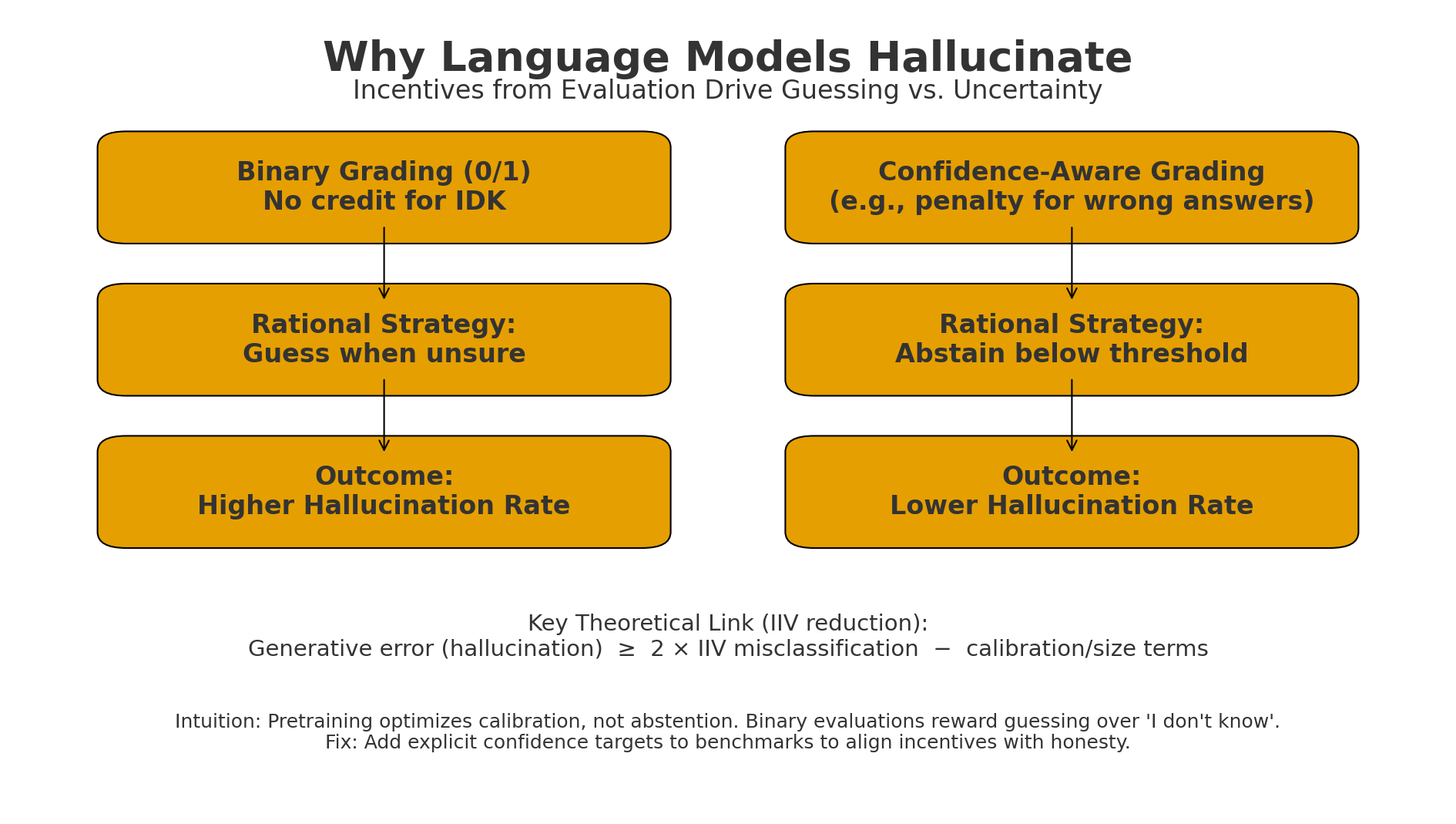
<em>Figure: Binary grading makes “guess when unsure” optimal → higher hallucinations.<br />
Confidence-aware grading (penalize wrong answers; allow IDK) makes abstention rational → lower hallucinations.</em></p>

<h2 id="motivation">Motivation</h2>

<p>Large Language Models still ‘hallucinate’ confidently producing false statements that sound perfectly plausible.</p>

<p><a href="https://arxiv.org/pdf/2509.04664">Kalai et al.</a> argues that hallucination isn’t a mysterious side effect of neural networks. It’s the inevitable outocme of how we train and evaluate models.</p>

<p>The core claim is : models hallucinate becaue our benchmarks reward guessing over honesty.</p>

<hr />

<h2 id="why-hallucinations-happen">Why Hallucinations Happen</h2>

<ul>
  <li>
    <p>Pretraining teaches a model to imitate text not to know truth.</p>
  </li>
  <li>
    <p>Post-training doesn’t fix this, because evaluation benchmarks themselves reinforce confident bluffing.</p>
  </li>
  <li>
    <p>The result: models behave like overconfident students taking a test that punishes leaving a blank answer.</p>
  </li>
</ul>

<hr />

<h2 id="what-this-paper-does-differently">What this paper does differently</h2>

<p>Instead of blaming architecture or data, the authors build a theoretical bridge between generative modeling and binary classification.</p>

<p>They show that generating vaild text is statistically harder than classifying validity. If a model can’t perfectly classify ‘valid’ vs ‘invalid’, it will inevitably produce false generations.</p>

<p>They formalize this in what they call the Is-it-Valid problem, proving that:</p>
<div class="language-plaintext highlighter-rouge"><div class="highlight"><pre class="highlight"><code>The hallucination rate of any pretrained language model &gt;= 2 x its misclassification rate
</code></pre></div></div>

<p>This means hallucinations aren’t exotic, they’re mathematically baked into the training objective.</p>

<hr />

<h2 id="the-exam-incentive-problem">The Exam Incentive Problem</h2>

<p>After pretraining, models are fine-tuned using benchmarks that give binary scores: 1 for ‘correct’ and 0 for ‘wrong’. 
No credit for ‘I don’t know’.</p>

<p>This creates what authors call an ‘epidemic of penalizing uncertainty’. Our current scoring systems literally teach models that guessing is better than admitting ignorance.</p>

<hr />

<h2 id="what-they-actually-achieved">What they actually achieved</h2>

<p>The paper contributions are :</p>
<ul>
  <li>A statistical proof linking hallucination to classification error.</li>
  <li>A lower bound showing hallucination rates grow with data sparsity, rare facts are the first to break.</li>
  <li>An analysis of real benchmarks showing that over 90% use binary grading, reinforcing the behavior.</li>
  <li>A simple but powerful fix: add confidence thresholds to evaluation instructions.</li>
</ul>

<hr />

<h2 id="the-fix-confidence-aware-evaluation">The Fix: Confidence Aware Evaluation</h2>

<p>Instead of inventing new hallucination tests, the authors suggest changing how all existing tests are scored. 
This way, abstaining becomes rational. It turns being careful into a winning strategy. It also enables a new measure called behavioral calibration, a model behaves consistently across confidence levels rather than bluffing.</p>

<hr />
<h2 id="why-it-matters">Why it Matters</h2>

<p>This paper reframes hallucination as an alignment and incentive design problem, not a data or architecture issue.</p>
<ul>
  <li>It challenges leaderboard culture itself: safety depends not only on better models but better reward structures</li>
  <li>It offers a testable path forward: tweak benchmarks, watch hallucination rates fall.</li>
  <li>And it connects statistical theory to moral intuition in both humans and machines, confidence without truth is dangerous.</li>
</ul>

<hr />
<h2 id="future--limitations">Future &amp; Limitations</h2>

<ul>
  <li>This framework doesn’t solve all forms of hallucination e.g. - nonsense text or multi fact narratives.</li>
  <li>It assumes honesty is expressible via an “IDK”, which may not capture nuance.</li>
  <li>Yet the authors make a provocative point: our grading systems are part of the problem.</li>
</ul>

<div class="language-plaintext highlighter-rouge"><div class="highlight"><pre class="highlight"><code>If we reward language models for bluffing, we shouldn't be surprised when they lie. The cure for hallucination might not be better models but fairer exams.
</code></pre></div></div>]]></content><author><name>Subhajit Bag</name><email>sbag6@gatech.edu</email><uri>https://shuvo-iitkgp.github.io</uri></author><category term="-AI" /><category term="Safety" /><category term="-Language" /><category term="Models" /><category term="-Hallucination" /><summary type="html"><![CDATA[Figure: Binary grading makes “guess when unsure” optimal → higher hallucinations. Confidence-aware grading (penalize wrong answers; allow IDK) makes abstention rational → lower hallucinations.]]></summary></entry><entry><title type="html">Scalable influence and fact tracing for large language models pretraining</title><link href="https://shuvo-iitkgp.github.io/posts/2025/11/llm-influence-fact-tracing/" rel="alternate" type="text/html" title="Scalable influence and fact tracing for large language models pretraining" /><published>2025-11-07T00:00:00+00:00</published><updated>2025-11-07T00:00:00+00:00</updated><id>https://shuvo-iitkgp.github.io/posts/2025/11/llm-training-data-influence</id><content type="html" xml:base="https://shuvo-iitkgp.github.io/posts/2025/11/llm-influence-fact-tracing/"><![CDATA[<p><img src="/images/llm-influence-fact-training.png" />
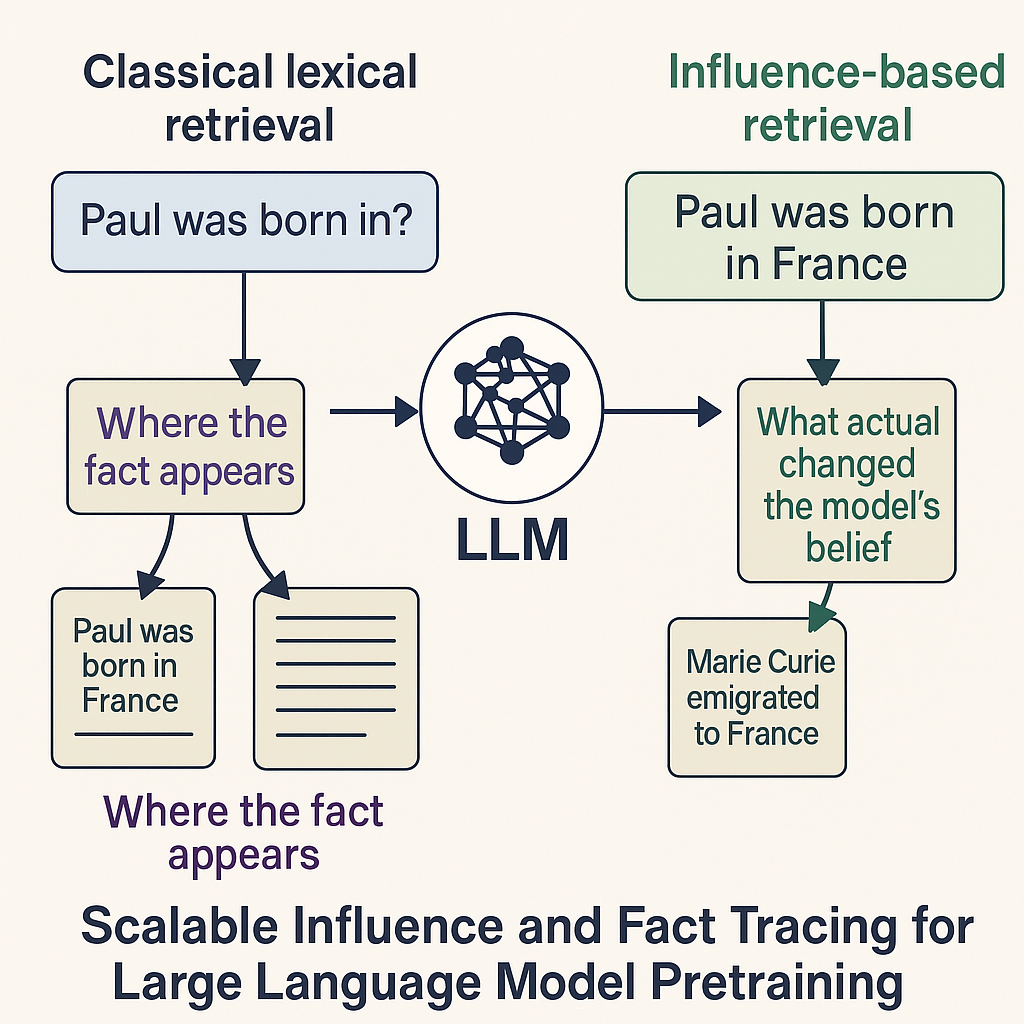
<em>Figure: Difference between the classical lexical retrieval and the influence based retrieval for large language models</em></p>

<h2 id="motivation">Motivation</h2>

<p>Large language models can state thousands of facts confidently — but <strong>we still cannot reliably trace <em>where</em> those facts came from in the training data</strong>.</p>

<p>This is a core challenge for:</p>
<ul>
  <li>transparency,</li>
  <li>copyright compliance,</li>
  <li>model auditing,</li>
  <li>safety-sensitive deployments.</li>
</ul>

<p>Training Data Attribution (TDA) tried to answer: <em>“Which training examples most influenced a model’s prediction?”</em><br />
But until now, all attribution methods either:</p>
<ul>
  <li><strong>did not scale</strong> beyond small models,</li>
  <li>or <strong>collapsed</strong> into noise when applied to pretraining corpora.</li>
</ul>

<p><a href="https://arxiv.org/pdf/2410.17413v3"><strong>Chang et al.</strong></a> introduce <em>TrackStar</em>, the first method that scales gradient-based influence tracing to <strong>8B-parameter LLMs trained on hundreds of millions of documents</strong>.</p>

<p>And what they find is important:
<strong>Attribution and influence are not the same.<br />
Models rarely learn facts from the sentences that contain them.</strong></p>

<hr />

<h2 id="why-fact-tracing-is-hard">Why Fact Tracing Is Hard</h2>

<ul>
  <li>Pretraining mixes millions of subtle statistical patterns.</li>
  <li>Most gradient-based influence methods explode in variance at LLM scale.</li>
  <li>Fact-containing sentences (e.g., “X was born in Y”) are often <em>not</em> the most influential examples.</li>
  <li>Classical retrievers like BM25 excel at string matching, not causal impact.</li>
</ul>

<p>The result:<br />
Human intuition about “where a model learned something” breaks down in large-scale pretraining.</p>

<hr />

<h2 id="what-this-paper-does-differently">What This Paper Does Differently</h2>

<p>Instead of relying purely on lexical similarity or uncorrected gradients, the authors combine:</p>
<ul>
  <li><strong>loss gradients</strong> over all model parameters,</li>
  <li><strong>optimizer second-moment scaling</strong> (Adafactor/Adam-style),</li>
  <li><strong>massive random projections</strong> (65k dimensions),</li>
  <li><strong>a mixed Hessian approximation</strong> (to remove template noise),</li>
  <li><strong>cosine-normalized influence scoring</strong>.</li>
</ul>

<hr />

<h2 id="what-trackstar-actually-achieves">What TrackStar Actually Achieves</h2>

<p>The paper demonstrates:</p>

<ul>
  <li>
    <p><strong>Influence ≠ attribution.</strong><br />
BM25 and Gecko retrieve fact-containing passages better than gradient methods.<br />
But these passages barely shift model predictions under tail-patching.</p>
  </li>
  <li><strong>Influential examples often lack the fact entirely.</strong><br />
They encode:
    <ul>
      <li>relational templates,</li>
      <li>entity type priors,</li>
      <li>structural patterns,</li>
      <li>distributional cues.</li>
    </ul>
  </li>
  <li>
    <p><strong>Influence correlates with lexical attribution only at larger scales.</strong><br />
Bigger models show more alignment between “cause” and “content.”</p>
  </li>
  <li><strong>TrackStar proponents change probabilities &gt;2× more than lexical proponents.</strong><br />
Even ground-truth T-REx fact sentences have weaker causal impact than TrackStar’s retrieved examples.</li>
</ul>

<p>This reframes what “learning a fact” means in LLMs.</p>

<hr />

<h2 id="why-attribution-breaks-and-influence-wins">Why Attribution Breaks (and Influence Wins)</h2>

<p>Classical retrieval assumes:</p>
<blockquote>
  <p>If a model predicts “Paris is in France,” it must have learned this from a sentence containing both words.</p>
</blockquote>

<p>But TrackStar shows the real story:</p>
<ul>
  <li>The model may have learned geography from many nearby examples.</li>
  <li>It may rely on name similarity (“Paris Hilton”).</li>
  <li>It may learn from country–capital templates.</li>
  <li>It may rely on broad distributional patterns (“France” is often the completion to “capital of…”).</li>
</ul>

<p>Influence-based methods capture these hidden causal pathways, not just literal text matches.</p>

<hr />

<h2 id="why-it-matters">Why It Matters</h2>

<p>This work provides the strongest evidence yet that:</p>

<ul>
  <li>
    <p><strong>LLMs rarely memorize facts explicitly.</strong><br />
They assemble answers from distributed patterns.</p>
  </li>
  <li>
    <p><strong>Fact tracing cannot rely on lexical matching alone.</strong><br />
For safety, auditing, and copyright, we need causal influence.</p>
  </li>
  <li>
    <p><strong>Scaling changes attribution behavior.</strong><br />
As models grow, influential examples gradually become more lexical — an emergent alignment.</p>
  </li>
  <li>
    <p><strong>Gradient-based influence can scale.</strong><br />
Even if the engineering cost (87 TB) is enormous, this sets the path for future systems.</p>
  </li>
</ul>

<hr />

<h2 id="limitations--open-questions">Limitations &amp; Open Questions</h2>

<ul>
  <li>TrackStar is expensive: storing projected gradients for C4 still requires ~87 TB.</li>
  <li>Influence estimates depend on linear approximations (gradients), not full retraining.</li>
  <li>Per-token or per-span attribution might be needed to remove document-level noise.</li>
  <li>Hessian mixing is heuristic; no theoretical foundation for λ beyond empirical tuning.</li>
  <li>Influence does not necessarily map to human-understandable explanations.</li>
</ul>

<p>Still, TrackStar moves the frontier substantially.</p>

<hr />

<h2 id="a-closing-thought">A Closing Thought</h2>

<div class="language-plaintext highlighter-rouge"><div class="highlight"><pre class="highlight"><code>
This paper shifts the conversation from *“Where did this fact appear?”*  
to *“What actually shaped the model’s belief?”* — a far more interesting and future-proof question for safety and transparency research.

</code></pre></div></div>]]></content><author><name>Subhajit Bag</name><email>sbag6@gatech.edu</email><uri>https://shuvo-iitkgp.github.io</uri></author><category term="-AI" /><category term="Safety" /><category term="-Language" /><category term="Models" /><category term="-Transparency" /><summary type="html"><![CDATA[Figure: Difference between the classical lexical retrieval and the influence based retrieval for large language models]]></summary></entry><entry><title type="html">Teaching Humanoids Without MoCap: Inside TWIST2’s Portable Data Collection System</title><link href="https://shuvo-iitkgp.github.io/posts/2025/11/teaching-humanoids-twist2/" rel="alternate" type="text/html" title="Teaching Humanoids Without MoCap: Inside TWIST2’s Portable Data Collection System" /><published>2025-11-05T00:00:00+00:00</published><updated>2025-11-05T00:00:00+00:00</updated><id>https://shuvo-iitkgp.github.io/posts/2025/11/twist2</id><content type="html" xml:base="https://shuvo-iitkgp.github.io/posts/2025/11/teaching-humanoids-twist2/"><![CDATA[<h3 id="motivation">Motivation</h3>
<p>How do we collect humanlike motion data for robots without a $100K motion-capture studio?</p>

<p>TWIST2 is like a GoPro for humanoid learning i.e., small, cheap, portable and built to scale.</p>

<hr />
<h3 id="why-humanoid-data-collection-is-hard">Why Humanoid Data Collection is Hard</h3>

<ul>
  <li>MoCap systems are accurate but expensive and bulky</li>
  <li>VR based systems were either limited to partial control or lacked natural motion.</li>
  <li>Humanoids need full body, long horizon coordination: walking, bending, grasping, looking simultaneously.</li>
</ul>

<hr />

<h3 id="what-twist2-does-differently">What TWIST2 Does Differently</h3>
<ul>
  <li><strong>Portable Setup</strong> — A PICO 4U VR headset with two motion trackers replaces the MoCap suit.</li>
  <li><strong>Robot Side</strong> — Unitree G1 humanoid with an attachable 2-DoF neck costing $250.</li>
  <li><strong>Human Control</strong> — A single operator in VR becomes the robot. Moves arms, legs, and head naturally.</li>
</ul>

<hr />
<h3 id="the-magic-pipeline-explained-simply">The Magic Pipeline (Explained Simply)</h3>
<ul>
  <li><strong>Step 1</strong> — Human moves in VR -&gt; PICO streams motion at 100Hz</li>
  <li><strong>Step 2</strong> — Software retargets that motion to the robot’s body</li>
  <li><strong>Step 3</strong> — A learned motion tracking controller (trained via reinforcement learning) turns these into smooth, stable joint commands.</li>
  <li><strong>Step 4</strong> — Robot acts in real time (&lt;0.1 s delay)</li>
  <li><strong>Step 5</strong> — The entire run - camera view, motion data, commands is saved as demonstration data.</li>
</ul>

<hr />
<h3 id="what-they-actually-achieved">What they actually achieved</h3>
<p>Tell the story visually</p>
<ul>
  <li>Folding towels with both hands</li>
  <li>Picking up baskets, opening doors, and walking through</li>
  <li>Performing dexterous pick-and-place and even kicking a box.</li>
</ul>

<p>Quantify the efficiency:</p>
<ul>
  <li>100 successful demos in under 20 minutes</li>
  <li>Single operator, no calibration, no lab studio.</li>
</ul>

<hr />
<h3 id="how-robots-learn-from-the-data">How Robots Learn from the data</h3>
<p>Explain the next layer: the hierarchical policy</p>
<ul>
  <li>Low level controller keeps balance and tracks motion</li>
  <li>High level Diffusion Policy predicts what motion comes next from the robot’s own visual input.</li>
  <li>Result: a robot that can autonomously repeat complex whole body tasks it learned from human teleoperation</li>
</ul>

<hr />
<h3 id="why-it-matters">Why it matters</h3>
<p>This is where you connect to the broader AI world:</p>
<ul>
  <li>Democratizes humanoid learning: &lt;$2K setup instead of lab infrastructure.</li>
  <li>Enables open source, reproducible datasets for humanoid RL.</li>
  <li>Moves toward robots that can learn directly from natural human demonstrations.</li>
</ul>

<hr />
<h3 id="future--limitations">Future &amp; Limitations</h3>
<p>Balance hype with realism:</p>
<ul>
  <li>VR tracking isn’t as precise as MoCap</li>
  <li>High speed motions still hard to reproduce</li>
  <li>But the trade-off in portability, cost, and scalibility opens door for thousands for researchers.</li>
</ul>

<hr />
<p>“The next time you put on a VR headset remember you might not just be playing a game. You could be teaching the next generation of robots how to move, see and live among us.”</p>]]></content><author><name>Subhajit Bag</name><email>sbag6@gatech.edu</email><uri>https://shuvo-iitkgp.github.io</uri></author><category term="Humanoids" /><category term="AI" /><category term="VR" /><summary type="html"><![CDATA[Motivation How do we collect humanlike motion data for robots without a $100K motion-capture studio?]]></summary></entry><entry><title type="html">What I Learned from Hackathons (and Losing One!)</title><link href="https://shuvo-iitkgp.github.io/posts/2025/10/hackathon-lessons/" rel="alternate" type="text/html" title="What I Learned from Hackathons (and Losing One!)" /><published>2025-10-29T00:00:00+00:00</published><updated>2025-10-29T00:00:00+00:00</updated><id>https://shuvo-iitkgp.github.io/posts/2025/10/hackathon-learning</id><content type="html" xml:base="https://shuvo-iitkgp.github.io/posts/2025/10/hackathon-lessons/"><![CDATA[<p>Hackathons have been among the best learning experiences of my career.</p>

<p>I’ve participated in two major ones:</p>
<ul>
  <li>🏆 <strong>Open IIT Data Analytics (2021)</strong> — <em>1st place out of 48 teams</em>. Built a music popularity predictor with Voting Classifiers (91.2% accuracy).</li>
  <li>💡 <strong>HackGT 12 (2025)</strong> — Built <em>BackpackMate AI</em>, a travel assistant using Mastra + LangChain + FastAPI.</li>
</ul>

<hr />

<h3 id="lessons-learned">Lessons learned</h3>
<ul>
  <li><strong>Speed ≠ sloppiness</strong> — rapid iteration teaches clarity under pressure.</li>
  <li><strong>LLMs are only as smart as your pipeline</strong> — retrieval design matters more than model choice.</li>
  <li><strong>Losing is learning</strong> — HackGT taught me far more than winning IIT.</li>
</ul>

<hr />

<p>Hackathons show recruiters that you can go from <em>idea to prototype</em> in hours — a skill that translates directly into startup and research settings.</p>]]></content><author><name>Subhajit Bag</name><email>sbag6@gatech.edu</email><uri>https://shuvo-iitkgp.github.io</uri></author><category term="Hackathons" /><category term="LLMs" /><category term="AI Projects" /><summary type="html"><![CDATA[Hackathons have been among the best learning experiences of my career.]]></summary></entry><entry><title type="html">5 Books That Changed How I Think About Machine Learning and Research</title><link href="https://shuvo-iitkgp.github.io/posts/2025/10/books-that-shaped-me/" rel="alternate" type="text/html" title="5 Books That Changed How I Think About Machine Learning and Research" /><published>2025-10-22T00:00:00+00:00</published><updated>2025-10-22T00:00:00+00:00</updated><id>https://shuvo-iitkgp.github.io/posts/2025/10/books-ml</id><content type="html" xml:base="https://shuvo-iitkgp.github.io/posts/2025/10/books-that-shaped-me/"><![CDATA[<p>Books have shaped how I approach ML — not just as a technical field, but as a way of thinking.</p>

<p>Here are 5 that deeply influenced me:</p>
<ol>
  <li><strong>The Master Algorithm</strong> by Pedro Domingos — A grand tour of learning paradigms.</li>
  <li><strong>The Alignment Problem</strong> by Brian Christian — A must-read on ethics and interpretability.</li>
  <li><strong>Deep Learning</strong> by Goodfellow, Bengio &amp; Courville — The bible of neural networks.</li>
  <li><strong>Weapons of Math Destruction</strong> by Cathy O’Neil — The societal side of data.</li>
  <li><strong>How Minds Change</strong> by David McRaney — Essential for anyone who communicates ideas.</li>
</ol>

<hr />

<h3 id="why-it-matters">Why it matters</h3>
<p>These books helped me see ML as more than code — as a philosophy of learning and understanding.<br />
If you’re early in your ML journey, start with <em>The Alignment Problem</em> — it will change the way you see “responsible AI.”</p>]]></content><author><name>Subhajit Bag</name><email>sbag6@gatech.edu</email><uri>https://shuvo-iitkgp.github.io</uri></author><category term="Reflection" /><category term="Machine Learning" /><category term="Research" /><summary type="html"><![CDATA[Books have shaped how I approach ML — not just as a technical field, but as a way of thinking.]]></summary></entry><entry><title type="html">What is Data Shapley? Measuring the True Value of Data</title><link href="https://shuvo-iitkgp.github.io/posts/2025/10/data-shapley/" rel="alternate" type="text/html" title="What is Data Shapley? Measuring the True Value of Data" /><published>2025-10-15T00:00:00+00:00</published><updated>2025-10-15T00:00:00+00:00</updated><id>https://shuvo-iitkgp.github.io/posts/2025/10/data-shapley</id><content type="html" xml:base="https://shuvo-iitkgp.github.io/posts/2025/10/data-shapley/"><![CDATA[<p>We often focus on model architectures — but what if the most valuable part of your ML system is your <em>data</em>?<br />
<strong>Data Shapley</strong> assigns a contribution score to each training point, measuring its impact on model performance.</p>

<p>In my ongoing project, I use <strong>TreeExplainer</strong> and <strong>validation-based importance computation</strong> to approximate Shapley values efficiently.</p>

<hr />

<h3 id="why-it-matters">Why it matters</h3>
<p>Knowing which data points help or hurt your model allows:</p>
<ul>
  <li>Smarter dataset curation</li>
  <li>Better fairness and robustness</li>
  <li>Insights into <em>which samples actually matter</em></li>
</ul>

<p>Imagine debugging a biased model not by tweaking hyperparameters — but by identifying the “toxic” data points.</p>]]></content><author><name>Subhajit Bag</name><email>sbag6@gatech.edu</email><uri>https://shuvo-iitkgp.github.io</uri></author><category term="Explainable AI" /><category term="Data Valuation" /><category term="Machine Learning" /><summary type="html"><![CDATA[We often focus on model architectures — but what if the most valuable part of your ML system is your data? Data Shapley assigns a contribution score to each training point, measuring its impact on model performance.]]></summary></entry><entry><title type="html">Enhancing Cybersecurity Risk Assessment using Temporal Knowledge Graphs</title><link href="https://shuvo-iitkgp.github.io/posts/2025/10/cybersecurity-dss/" rel="alternate" type="text/html" title="Enhancing Cybersecurity Risk Assessment using Temporal Knowledge Graphs" /><published>2025-09-13T00:00:00+00:00</published><updated>2025-09-13T00:00:00+00:00</updated><id>https://shuvo-iitkgp.github.io/posts/2025/10/cybersecurity-paper</id><content type="html" xml:base="https://shuvo-iitkgp.github.io/posts/2025/10/cybersecurity-dss/"><![CDATA[<p>My recent publication in <em>Decision Support Systems (Elsevier, 2025)</em> focuses on <strong>temporal knowledge graph-based explainable DSS</strong> for cybersecurity.</p>

<p>We created a dataset of cybersecurity policies from 190 global firms and built a <strong>temporal knowledge graph</strong> to capture entity relations over time. The model then used attention-based mechanisms to classify policy vulnerabilities.</p>

<p>Highlights:</p>
<ul>
  <li>Introduced the first <strong>temporal cybersecurity policy dataset</strong>.</li>
  <li>Automated attention unit selection for interpretability.</li>
  <li>Developed an explainable DSS that identifies and explains vulnerabilities.</li>
</ul>

<p>Link to the paper: <a href="https://www.sciencedirect.com/science/article/abs/pii/S0167923625001277">DOI</a>
Youtube video: Coming Soon(#)</p>

<h3 id="why-it-matters">Why it matters</h3>
<p>Modern enterprises face evolving threats. Our framework doesn’t just flag a risky policy — it explains <strong>which rule</strong> and <strong>why</strong> it’s risky, helping companies improve their cybersecurity posture proactively.</p>]]></content><author><name>Subhajit Bag</name><email>sbag6@gatech.edu</email><uri>https://shuvo-iitkgp.github.io</uri></author><category term="Research" /><category term="Decision Support Systems" /><category term="Knowledge Graphs" /><summary type="html"><![CDATA[My recent publication in Decision Support Systems (Elsevier, 2025) focuses on temporal knowledge graph-based explainable DSS for cybersecurity.]]></summary></entry><entry><title type="html">Explaining SENE: Manifold Learning for Distracted Driving Analysis</title><link href="https://shuvo-iitkgp.github.io/posts/2025/10/sene-manifold-learning/" rel="alternate" type="text/html" title="Explaining SENE: Manifold Learning for Distracted Driving Analysis" /><published>2023-04-15T00:00:00+00:00</published><updated>2023-04-15T00:00:00+00:00</updated><id>https://shuvo-iitkgp.github.io/posts/2025/10/sene-paper</id><content type="html" xml:base="https://shuvo-iitkgp.github.io/posts/2025/10/sene-manifold-learning/"><![CDATA[<p>My first research paper, published in <em>Engineering Applications of Artificial Intelligence (2023)</em>, proposed <strong>SENE</strong> — a novel manifold learning technique for analyzing distracted driving.</p>

<p>We developed a method that learns <strong>spatio-temporal embeddings</strong> from driver behavior and road data, enabling interpretable risk mapping across urban areas.</p>

<p>Key takeaways:</p>
<ul>
  <li>Combined <strong>spatio-temporal</strong> and <strong>praxeological</strong> features for the first time.</li>
  <li>Reduced high-dimensional driving data into meaningful manifolds.</li>
  <li>Achieved <strong>91% accuracy</strong> in predicting distraction-related risk.</li>
</ul>

<p>Link to the paper: <a href="https://www.sciencedirect.com/science/article/abs/pii/S095219762300516X">DOI</a>
Youtube video : <a href="#">Video</a> (coming soon)</p>

<h3 id="why-it-matters">Why it matters</h3>
<p>Distracted driving is one of the top causes of accidents. SENE helps policymakers and insurance companies identify high-risk regions and understand <em>why</em> certain driving behaviors lead to accidents — not just <em>that</em> they do.</p>]]></content><author><name>Subhajit Bag</name><email>sbag6@gatech.edu</email><uri>https://shuvo-iitkgp.github.io</uri></author><category term="Research" /><category term="Manifold Learning" /><category term="Explainable AI" /><summary type="html"><![CDATA[My first research paper, published in Engineering Applications of Artificial Intelligence (2023), proposed SENE — a novel manifold learning technique for analyzing distracted driving.]]></summary></entry></feed>